
Competency-Based Interviews at International Organisations: A Complete Guide
· PanelPrep Team
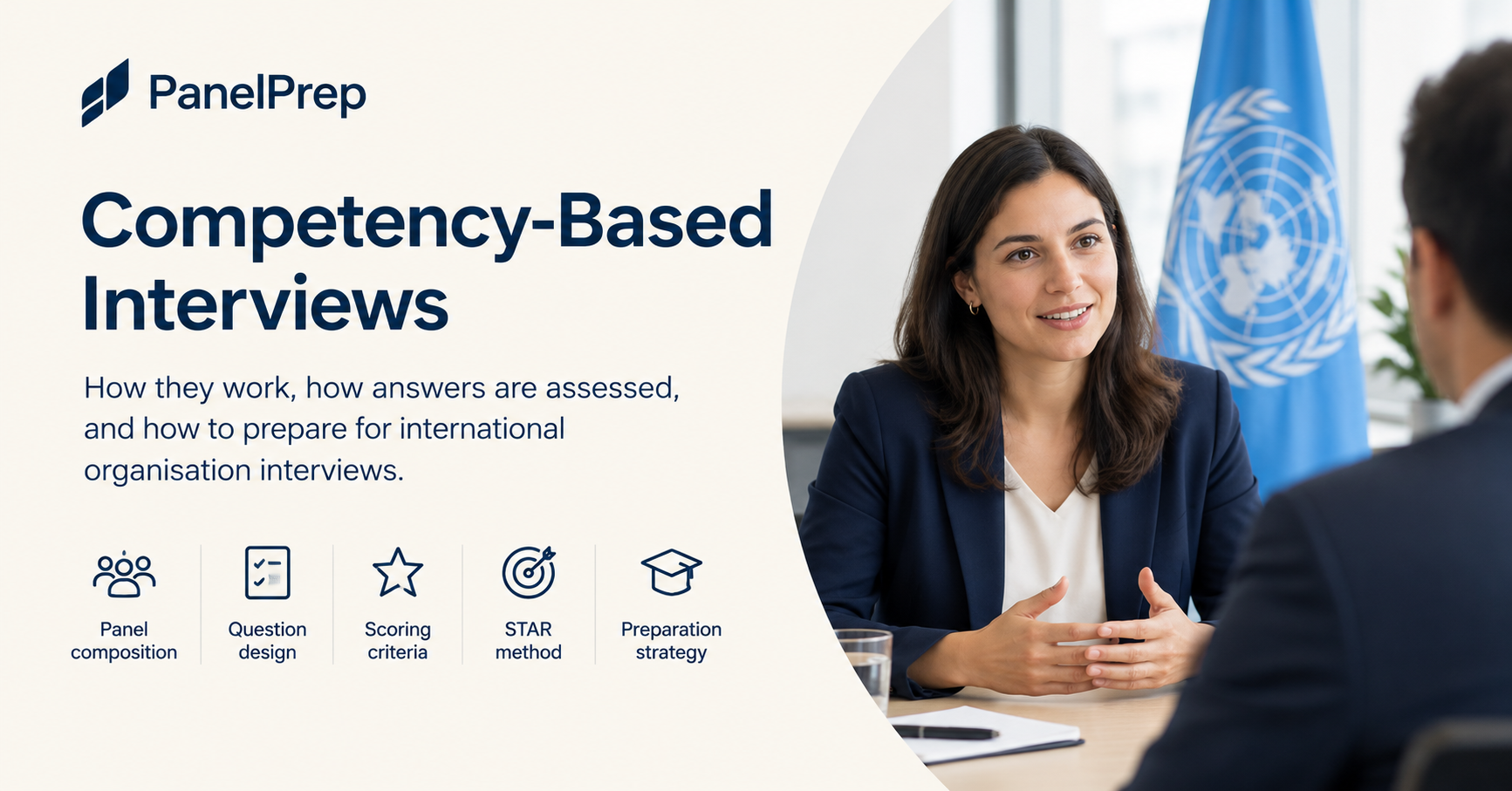
Competency-Based Interviews at International Organisations: A Practical Guide
Competency-based interviews (CBIs), also known as behavioural interviews, are widely used in recruitment to international organisations. They are designed to assess not only what candidates know, but also how they have applied their knowledge, exercised judgement, worked with others and responded to professional challenges.
The United Nations describes its structured interview process as an assessment of candidates' competencies through their previous experience and behaviour. Rather than relying solely on general impressions, the interview focuses on evidence relevant to the requirements of the position. The exact procedure varies between organisations, however, and candidates should always consult the vacancy announcement and the instructions provided by the recruiting organisation.
Understanding how a competency-based interview works makes preparation more systematic. Instead of memorising impressive-sounding answers, candidates can identify relevant experiences, structure their examples and demonstrate the behaviours that the position requires.
1. What Is a Competency-Based Interview?
A competency is a combination of skills, knowledge, abilities and behaviours that contributes to effective performance in a particular role. Depending on the organisation and position, competencies may include communication, teamwork, planning and organising, accountability, judgement, professionalism, leadership or the ability to handle uncertain situations.
A competency-based interview seeks evidence that a candidate has demonstrated the relevant behaviours in practice. It therefore differs from an unstructured conversation in which the panel might focus primarily on career history, motivation or general impressions.
For example, a question such as “Tell us about a time when you had to manage competing priorities” asks the candidate to describe a real experience. The panel can then assess how the candidate identified priorities, allocated resources, communicated constraints, made decisions and delivered results.
Behavioural questions focus on past experience, while situational questions present a hypothetical challenge and ask how the candidate would respond. A competency-based assessment may use either approach, depending on the competency and recruitment process. Some selection procedures also combine interviews with written exercises, technical tests, presentations or other assessments.
The underlying principle is that candidates should provide specific, relevant evidence rather than simply assert that they possess a particular quality.
2. How the Interview Fits into the Recruitment Process
A competency-based interview is generally one stage of a broader selection procedure. For example, a candidate applying to the UN may first undergo an assessment of eligibility and qualifications before being invited to complete an assessment exercise or attend an interview.
The interview may take place in person, by telephone or by video conference. The format, duration and assessment requirements depend on the vacancy and the organisation.
The competencies identified in the vacancy announcement are especially important. They indicate the behaviours and capabilities against which the candidate will be assessed. In the UN Secretariat, official guidance explains that the competencies specified in the job opening must be considered in the assessment process. Depending on the procedure, some may be evaluated through the interview and others through a different assessment method.
This distinction matters: candidates should prepare for every competency identified in the vacancy, but should not assume that each competency will necessarily correspond to one separate interview question.
Before preparing answers, read the vacancy announcement carefully. Pay attention to the responsibilities of the position, the required competencies, any behavioural indicators and the stated assessment method. The goal is to understand what effective performance would look like in the particular role.
3. Who Sits on the Interview Panel?
Many international-organisation interviews are conducted by a panel rather than by a single interviewer. In its applicant guidance, the UN describes a panel normally consisting of three UN staff members, including the hiring manager.
Panel composition and responsibilities vary across organisations and recruitment procedures. It would therefore be misleading to assume that every panel has the same number of members or always includes a particular combination of human resources, technical or diversity representatives.
A panel may bring together different perspectives on the position. The hiring manager or subject-matter specialists may be particularly familiar with the work and its technical requirements, while other members may focus on the competencies and assessment criteria. The precise division of responsibilities depends on the procedure.
For candidates, the practical implication is straightforward: prepare to communicate your example clearly to people who may not share your technical specialisation. Explain relevant context, avoid unexplained acronyms and make your personal contribution understandable.
The objective is not to tailor a different answer to each interviewer. It is to provide clear evidence that can be assessed against the requirements of the position.
4. How Are Competency-Based Questions Designed?
Questions are intended to elicit evidence about competencies relevant to the job. They may be framed around a particular situation, a difficult decision, a professional disagreement, a deadline or an achievement.
Examples include:
- “Tell us about a time when you had to work with someone whose approach differed significantly from yours.”
- “Describe a situation in which you had to deliver several assignments under tight deadlines.”
- “Give an example of a difficult decision you made with incomplete information.”
- “Tell us about a time when you received critical feedback. How did you respond?”
- “Describe a situation in which you identified a problem and took steps to resolve it.”
The wording of the questions is important, but the competency being assessed is more important still. A question about competing deadlines, for instance, may explore planning and organising, judgement, accountability or communication, depending on the criteria and the evidence sought.
Structured interviews aim to make assessment more consistent. In a highly structured format, candidates receive the same predetermined core questions and are evaluated against common criteria. Other procedures allow more flexibility in the questions or follow-up discussions.
The UN's published guidance advises candidates to expect probing questions when the panel requires further evidence. A candidate should consequently be prepared to explain not only what happened, but also why they acted as they did, what alternatives they considered and what the outcome was.
5. How Are Answers Evaluated?
In a competency-based interview, the strength of an answer depends on the evidence it provides for the relevant competency. General confidence, seniority or an impressive institutional setting cannot substitute for a clear account of relevant behaviour.
Structured interview methodologies commonly use rating scales and defined assessment criteria to evaluate answers. The US Office of Personnel Management, for example, explains that structured interviews assess candidates against job-related competencies and use common questions and rating standards to support more consistent evaluation. International organisations have their own procedures, so candidates should not assume that a particular numerical scale or weighting applies everywhere.
In practice, a strong answer will usually make several elements clear:
Relevance. The example directly addresses the question and illustrates the required competency.
Personal contribution. The candidate explains what they personally did, rather than describing only what the team or organisation achieved.
Judgement and reasoning. The answer reveals how the candidate understood the problem, assessed available options, managed competing considerations and chose a course of action.
Execution. The candidate describes the steps taken, including relevant obstacles, collaboration, communication or adjustments along the way.
Results and learning. The answer explains what happened, what changed as a result and, where appropriate, what the candidate learned.
An answer can be unconvincing even when the underlying experience is substantial. Consider a candidate who says, “We successfully resolved a difficult situation.” That statement establishes an outcome but says little about the candidate's role, the decisions they made or the behaviours they demonstrated.
A more useful answer explains the problem, the candidate's responsibilities, the actions taken and the consequences. If the result was mixed or the initiative did not succeed as intended, the candidate can still demonstrate judgement, accountability and learning by explaining the constraints, their response and what they would do differently.
The objective is not to portray every experience as a perfect success. It is to provide credible and relevant evidence.
6. How to Structure Your Answers: The STAR Method
The STAR method is a widely used framework for organising behavioural interview answers. It stands for Situation, Task, Action and Result.
Situation: Briefly explain the circumstances. What was happening, and why was it significant?
Task: Describe your responsibility, objective or specific challenge. What were you expected to achieve or resolve?
Action: Explain what you personally did. What options did you consider? How did you approach the problem, involve others, make decisions or respond to obstacles?
Result: State the outcome. What was achieved, improved, resolved or learned? Where possible, identify concrete consequences rather than relying on vague claims of success.
The most important part is generally the Action section. Candidates sometimes spend too much time establishing the background and leave insufficient time to explain their own decisions and contribution.
For example, a candidate answering a question about teamwork might describe a disagreement over how to deliver a project. The answer should briefly explain the source of the disagreement, identify the candidate's responsibility, describe how they engaged with colleagues and worked towards a solution, and explain what happened afterwards.
STAR is a preparation and communication tool, not a rigid script. Some questions require a different emphasis, and candidates should not force every answer into an identical formula. A concise, natural explanation is more useful than a mechanically delivered account.
7. Preparing Examples for the Competencies in the Vacancy
Effective preparation begins with the job opening, not with a collection of generic interview answers.
First, identify each competency stated in the vacancy announcement. Where behavioural indicators are provided, read them carefully. The label alone may be too broad to guide your preparation: “Communication”, for instance, could involve adapting a message to a particular audience, handling a sensitive disagreement, explaining complex information or ensuring that colleagues have the information necessary to act.
Second, identify experiences that demonstrate the relevant behaviours. These examples can come from professional employment, internships, academic projects, volunteering or other relevant responsibilities, provided they are appropriate to the question and the position.
Third, create a competency-to-example matrix. For each competency, note one or more examples and the specific actions that demonstrate it. An individual example may be relevant to several competencies, but the answer must still address the competency being tested by the particular question.
It is useful to prepare examples involving different types of experience, including:
- An achievement or assignment of which you are particularly proud.
- A difficult professional relationship or disagreement.
- Competing priorities or a demanding deadline.
- A decision made under uncertainty or with incomplete information.
- A mistake, setback or critical piece of feedback.
- An instance of initiative, process improvement or learning.
This is a preparation strategy, not an official requirement to prepare a fixed number of stories. The objective is to develop a sufficiently broad range of genuine examples that you can select the most relevant one when a question is asked.
Finally, practise explaining each example aloud. A story that seems clear in written notes may become unnecessarily long or disorganised when delivered under pressure. Practise giving the essential context, explaining your actions in a logical sequence and ending with the result or lesson learned.
8. Handling Follow-Up Questions
Follow-up questions are a normal part of competency-based interviews. They allow the panel to clarify the facts, understand the candidate's personal contribution or obtain evidence that has not yet emerged.
Typical follow-ups include:
- “What exactly did you do?”
- “Why did you choose that approach?”
- “What alternatives did you consider?”
- “How did the other people involved react?”
- “What was the result?”
- “What would you do differently today?”
A follow-up question does not necessarily mean that an answer was poor. It may simply indicate that the panel needs more detail to evaluate the evidence.
Candidates should answer the question asked rather than repeat the entire story. If an interviewer asks about a personal decision, focus on the reasoning and actions behind that decision. If asked about the result, explain the consequences and distinguish your own contribution from the work of others.
Preparation should include the details behind each example: your role, the constraints, the alternatives considered, the people involved and the outcome. Memorising a polished narrative without understanding these details can make it difficult to answer probing questions naturally.
Candidates should also respect confidentiality obligations. In international organisations, examples may involve sensitive cases, internal deliberations or protected information. It is possible to explain the professional challenge and one's actions without disclosing confidential details, identifying protected individuals or revealing restricted information.
9. Common Mistakes to Avoid
Speaking in generalities. Statements such as “I am a good communicator” or “I work well under pressure” describe a self-assessment, not evidence. Support such claims with a relevant example.
Overemphasising the context. Excessive background leaves less time for the actions that demonstrate the competency. Provide only the information necessary to understand the challenge.
Using “we” throughout the answer. Team achievements matter, but the panel also needs to understand your own role. Explain how you contributed while recognising the work of colleagues.
Describing actions without explaining the reasoning. Listing steps is helpful, but a strong answer also explains the relevant choices, priorities and considerations behind them.
Failing to explain the result. An answer that ends when the action is completed leaves the panel without a clear understanding of the outcome. Explain what happened and what you learned, even when the result was not entirely positive.
Giving a rehearsed answer that does not address the question. A well-prepared example is useful only when it responds to the competency being assessed. Listen carefully and adapt the emphasis accordingly.
Inventing or exaggerating achievements. Examples should be accurate and defensible under follow-up questions. Credibility depends on being able to explain the circumstances and your contribution consistently.
10. A Practical Checklist Before the Interview
Before the interview, review the vacancy announcement and the competencies on which you expect to be assessed. Prepare a range of real examples and map them against the relevant behaviours. Practise the STAR structure, paying particular attention to your personal actions, reasoning and results.
Research the mandate, priorities and work of the department or office. This helps you understand why the competencies matter in the context of the position, although it does not replace the need to provide evidence from your own experience.
Check the interview arrangements, timing and technical requirements. During the interview, listen carefully, ask for clarification if a question is unclear, and keep your answers focused. Where a question asks about a past experience, describe what actually happened; where it asks about a hypothetical scenario, explain how you would approach it.
After practising, review your answers critically. Does each example address the question? Is your personal contribution clear? Have you explained the result? Could you answer detailed follow-up questions about the choices you made?
Conclusion: Prepare Evidence, Not Just Answers
Competency-based interviews reward preparation, but not simply the memorisation of model answers. Their purpose is to give the selection panel evidence of how candidates have demonstrated job-related competencies.
For candidates applying to the UN, ICC and other international organisations, the most effective preparation combines a careful reading of the vacancy announcement, a structured bank of genuine examples, clear STAR-based answers and practice responding to follow-up questions.
A strong answer does not need to describe a spectacular achievement. It needs to show, credibly and specifically, how you approached a relevant challenge, what you contributed and what the experience demonstrates about your ability to perform the job.
Further Reading
- United Nations Careers: How to Apply and Prepare for an Interview
- United Nations Human Resources Portal: Competency-Based Interview Training for Applicants
- United Nations Inspira Applicant Guide
- U.S. Office of Personnel Management: Structured Interviews
Recruitment procedures vary between international organisations and individual vacancies. Always follow the instructions and assessment criteria provided for the position to which you are applying.